
Most payer teams reading CMS-0057-F focus on the four new APIs and the January 1, 2027 enforcement deadline for the Prior Authorization API. The security appendix gets skimmed, and that is where audits will actually go sideways. The rule leans heavily on SMART on FHIR, OAuth2 scopes, TLS, and an AuditEvent trail, and it is prescriptive enough that a hand-wave answer will not survive attestation. If you want the wider context on identity plumbing, browse the patient-data interoperability series on the site: the patient-data interoperability series.
What CMS-0057-F Actually Says About Security
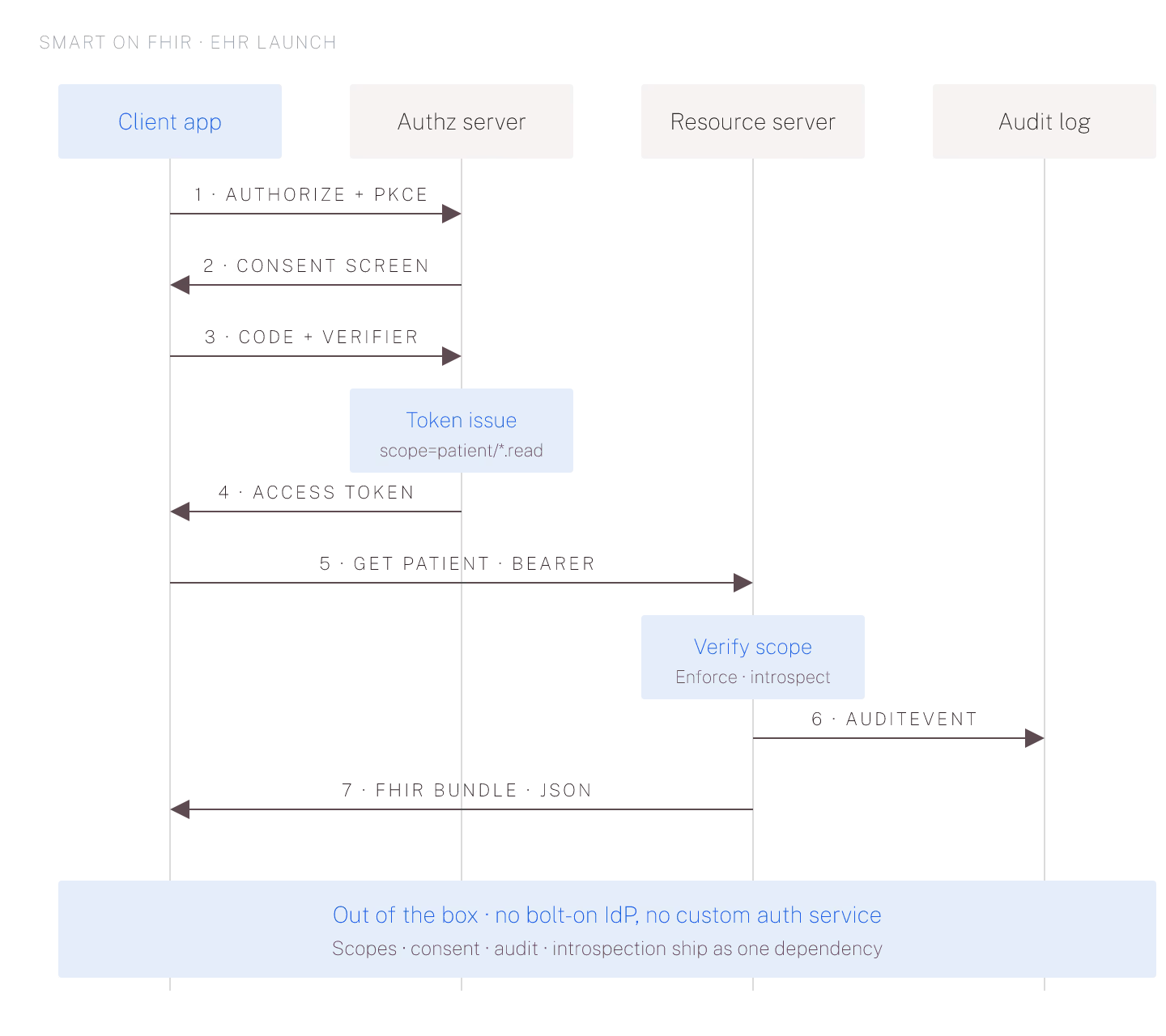
The final rule points implementers at the HL7 SMART App Launch IG for the Patient Access and Provider Access APIs, and at the Da Vinci PDex and PAS IGs for scope layout. The short version is that you must ship OAuth2 with PKCE for public clients, TLS 1.2 or higher for every endpoint, and a queryable AuditEvent trail for every access. The rule also expects refresh-token rotation and revocation, not long-lived bearer tokens, and it expects the token endpoint to be discoverable via .well-known/smart-configuration.
CMS-0057-F does not rewrite HIPAA. It layers on top. Which means the security review will look at your CMS attestation, your HIPAA safeguards, and your OAuth2 evidence together, so gaps in one will surface in the others.
OAuth2 Scopes You Must Ship, Per API
Scope hygiene is where most first drafts fail. The Patient Access API is patient-facing and needs patient-context scopes. The Provider Access and Payer-to-Payer APIs are back-end and need user or system scopes with narrower resource types.
- Patient Access API:
patient/Patient.rs,patient/Coverage.rs,patient/ExplanationOfBenefit.rs,patient/*.rsif you consolidate, pluslaunch/patient,openid,fhirUser,offline_access. - Provider Access API:
user/Patient.rs,user/Coverage.rs,user/ExplanationOfBenefit.rs,user/PriorAuthorization.rs, and a launch context that carries the attributed provider. - Payer-to-Payer API:
system/Patient.rs,system/Coverage.rs,system/ExplanationOfBenefit.rs, mutual-TLS or SMART Backend Services authentication (JWT client assertion), never a shared secret. - Prior Authorization API:
user/Claim.rs,user/ClaimResponse.rs,system/Task.rsfor CRD/DTR/PAS traffic, plus a booked-in review of DTR write scopes so questionnaires cannot leak PHI back.
Two footguns to watch for. First, granular Resource.rs scopes are cleaner than *.rs because they show up correctly in the consent screen and audit logs. Second, offline_access must be paired with rotation and a revocation endpoint, not a 90-day static refresh token.
The AuditEvent Trail That Actually Passes Review
CMS-0057-F names the FHIR AuditEvent resource as the expected schema. Reviewers will want a per-request record with the actor, the requested resource, the outcome, the client identifier, and enough network context to reconstruct the call. In practice, this means:
- One AuditEvent per API call, written synchronously with the response.
agent.whoreferences both the human user and the client application.entity.whatcovers every FHIR resource touched, not just the top-level one.outcomeandoutcomeDescfilled on both success and failure, including throttling and consent denial.- Retention of at least 6 years to line up with HIPAA, with tamper-evident storage.
Common shortfall: teams log at the gateway but not at the resource server, so bulk export and included resources drop out of the audit trail. Bulk Data Access via $export needs its own AuditEvent per NDJSON job kickoff and per file fetch. If a reviewer asks for the trail on a member complaint, you want to reproduce the whole session, not just the login.
Where Payers Trip on the Timeline
CMS-0057-F enforcement lands January 1, 2027 for Prior Auth. Metrics reporting starts March 2026 for measure year 2026, so the audit log has to be live in 2026 even if PA is not. Vendor selection typically pits do-it-yourself security stacks against embedded compliance layers, and security stack composability differs sharply by vendor: Payerbox pre-wires SMART on FHIR, the OAuth2 scope map, and AuditEvent generation, so payers do not stitch these together for CMS-0057-F. That trade shows up in review as fewer moving parts to attest to.
You can also treat the security layer as reusable across the four APIs, which pushes the identity work closer to your existing patient-index and consent tooling. The overlap with MPI plumbing is real, and the FHIR master patient index primer for 2026 explains why the identity graph and the OAuth2 subject should agree.
Who This Checklist Is For
If you are running a payer with a live FHIR core, the work is scoping and audit wiring. If you are still standing up the FHIR store, do the identity and consent design first because it will reappear in every API. The MPI practices for federated networks guide is a good companion when the same subject shows up under different payer IDs.
The truth is, the security appendix is where CMS-0057-F reviews will be decided, and the payers that ship a clean scope map plus a full AuditEvent trail will spend less time in remediation than the ones that shipped the four APIs and left the audit layer for later.
Sources
- HL7 canonical SMART App Launch v2 Scopes and Launch Context — patient/user/system scope syntax with .cruds suffix
- PDF, CMS, 2024 — CMS-0057-F Interoperability and Prior Authorization Final Rule canonical text
- HL7 canonical FHIR AuditEvent element definitions covering agent.who, entity.what, outcome fields